
Last Will and Testament Forms
A last will and testament says who receives your property after your death and names an executor to settle your estate. Choose the will form that fits your situation.
Last will and testament forms
These forms are not written for any one state. Some are versions of the same will (noted on each card), and the estate planning worksheets help you gather information first. Signing and witness requirements for wills vary by state, so check the rules where you live before you sign.
Last Will and Testament Form
A will for a married person with children: names your spouse and children, leaves the remaining estate to your spouse, then to your children.
Do It Yourself Will Kit for Married Person
The married-person-with-children will in its do-it-yourself kit version (notary block with a commission line).
Do It Yourself Will
The same will as the Last Will and Testament Form above, in a separate download.
Simple Will for Single Person
A will for a single person: specific gifts, the rest of the estate shared among the people you name by percentage, and an executor.
Do It Yourself Will Kit for Single Person
The single-person will in its do-it-yourself kit version, with an extra line for a second residuary beneficiary.
Joint Will Form
A joint will for a married couple, made under an agreement between the spouses: everything to the survivor, then to the children equally.
Pour Over Will
A pour-over will that leaves your property to the trustee of an existing trust, to be distributed under that trust.
Codicil to Will Form
A codicil changes or adds to an existing will without rewriting it.
Estate Planning Form Married
A worksheet for collecting the information a married person needs before preparing a will. It is not a will.
Estate Planning Form Single
A worksheet for collecting the information a single person needs before preparing a will. It is not a will.
About Last Will and Testament Forms
A last will and testament is a written document in which a person (the testator) says how their property should be distributed after death and nominates an executor to carry out those wishes. The forms on this page include sections for specific gifts, the rest of the estate (the residuary estate), the executor and the executor's powers.
Each will form ends with signature lines for the testator and two witnesses, followed by an affidavit that can be signed before a notary. Whether that affidavit is needed, and how many witnesses are required, depends on the law of your state.
A will covers property that passes under the will. Some assets, such as accounts with a named beneficiary or property held in a trust, may pass outside the will.
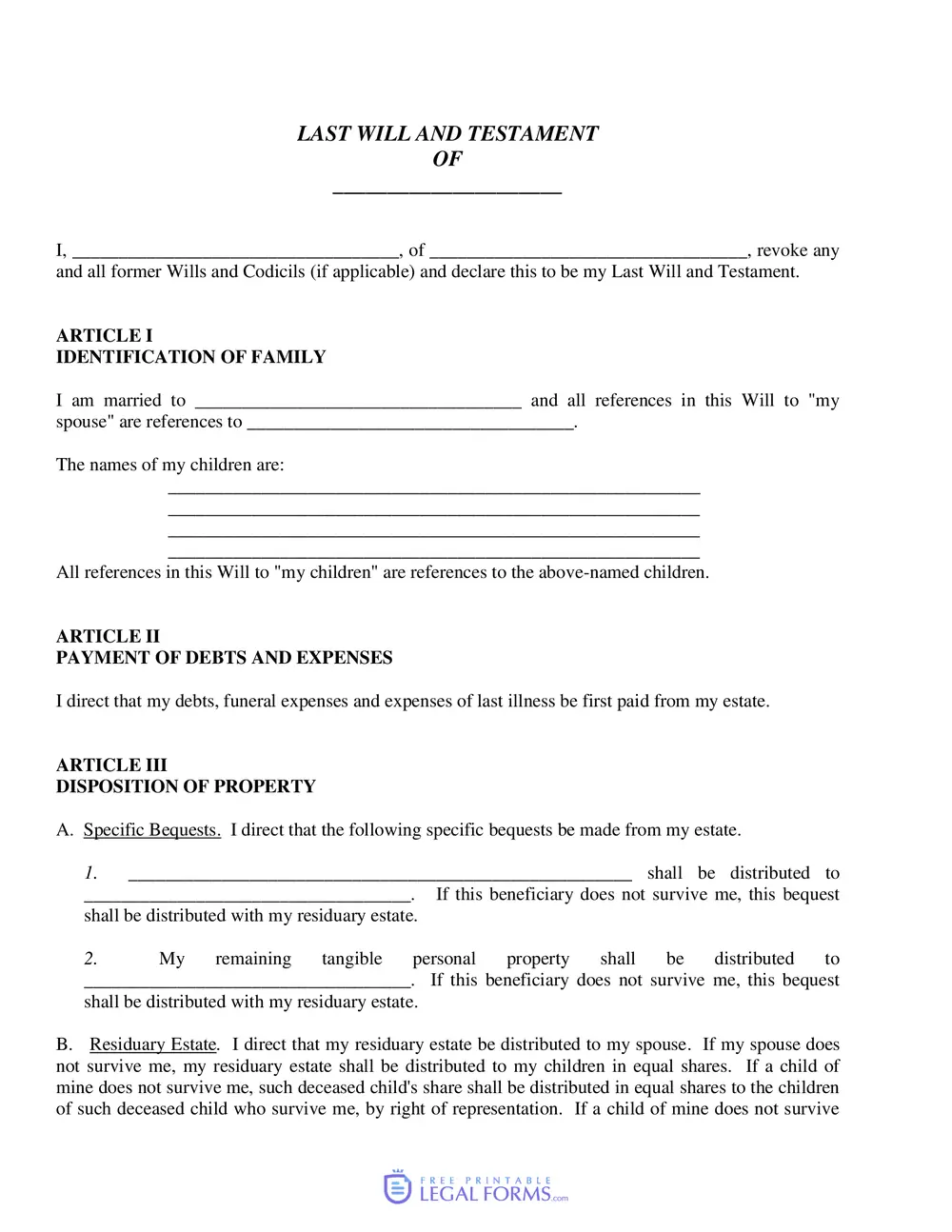
Example of a Last Will and Testament
A last will and testament form typically includes the testator's details, the family members named in the will, specific gifts, the residuary estate, the executor nomination, and signature lines for the testator and witnesses.
Common questions
What is the difference between a last will and a living will?
A last will and testament deals with your property after your death. A living will records your wishes about medical treatment while you are alive but unable to decide for yourself. Living will forms are on our Living Will and Advance Directives pages.
Do I need a lawyer to make a will?
You are not generally required to use a lawyer, but wills must meet the signing and witness requirements of your state to be valid. If your situation is complex, consider getting legal advice.
Does a will have to be notarized?
In many states a will does not need to be notarized to be valid, but it must be signed and witnessed as state law requires. The affidavit at the end of these forms is signed before a notary and can make the will easier to prove in some states.
How do I change my will later?
You can make a new will, which usually revokes earlier wills, or sign a codicil that changes specific parts of the existing will. A codicil must be signed and witnessed like a will.
Where should I keep my will?
Keep the signed original in a safe place and tell your executor where to find it.
Important Legal Information
Wills must meet the requirements of state law, including rules about who may sign as a witness. Before signing, review the form carefully and confirm the requirements that apply in your state.
The forms provided on this website are for general informational purposes and are not a substitute for legal advice. Free Printable Legal Forms does not assume responsibility for the accuracy, completeness, effectiveness, or use of any form provided on this website.
Can’t Find the Form You Need?
Search all available legal forms by keyword, state, or category.
Search All Legal Forms →