
Power of Attorney Forms
A power of attorney lets you name someone you trust, your agent, to act for you in financial, legal or health care matters. Choose the type you need, or go straight to the forms for your state.
Power of attorney by type
Durable Power of Attorney Forms
Find forms for granting authority that may continue if you become incapacitated.
View Forms: Durable Power of Attorney FormsFinancial Power of Attorney Forms
Find forms for authorizing someone to manage financial or property matters.
View Forms: Financial Power of Attorney FormsMedical Power of Attorney Forms
Find forms for appointing someone to make health care decisions on your behalf.
View Forms: Medical Power of Attorney FormsMental Health Power of Attorney Forms
Find forms for recording your mental health treatment choices and naming someone to carry them out.
View Forms: Mental Health Power of Attorney Forms
Power of attorney forms by state
Select your state to see the power of attorney forms we have for it.
General power of attorney forms
These documents are not written for any one state. Before using one, check the signing, witness and notarization rules that apply where you live.
Durable Financial Power of Attorney Form
A durable power of attorney for financial and property matters.
Limited Power of Attorney Form
Gives an agent authority only for the specific powers you list.
Medical Power of Attorney Form
Appoints a health care representative to make health care decisions for you.
Revocation of Power of Attorney Form
Used to revoke a power of attorney you signed earlier.
About Power of Attorney Forms
A power of attorney is a written document in which one person, the principal, authorizes another person, the agent, to act on their behalf. In some states the agent is called an attorney-in-fact. Depending on the document, the agent may handle financial matters, property, legal transactions or health care decisions.
The forms here are grouped by type. Durable forms are generally written to remain in effect if the principal becomes incapacitated. Financial forms cover money and property. Medical and mental health forms appoint someone to make health care or mental health treatment decisions. A limited power of attorney covers only the powers it lists. A revocation form is used to put in writing that the principal is withdrawing an earlier power of attorney; when the revocation takes effect, and who needs to be told about it, depends on the governing law and the circumstances.
Some states provide their own statutory power of attorney forms, and the requirements for signing and using a power of attorney vary by jurisdiction and by type of authority. Where a form is available for your state, start there, and review any general form carefully before relying on it.
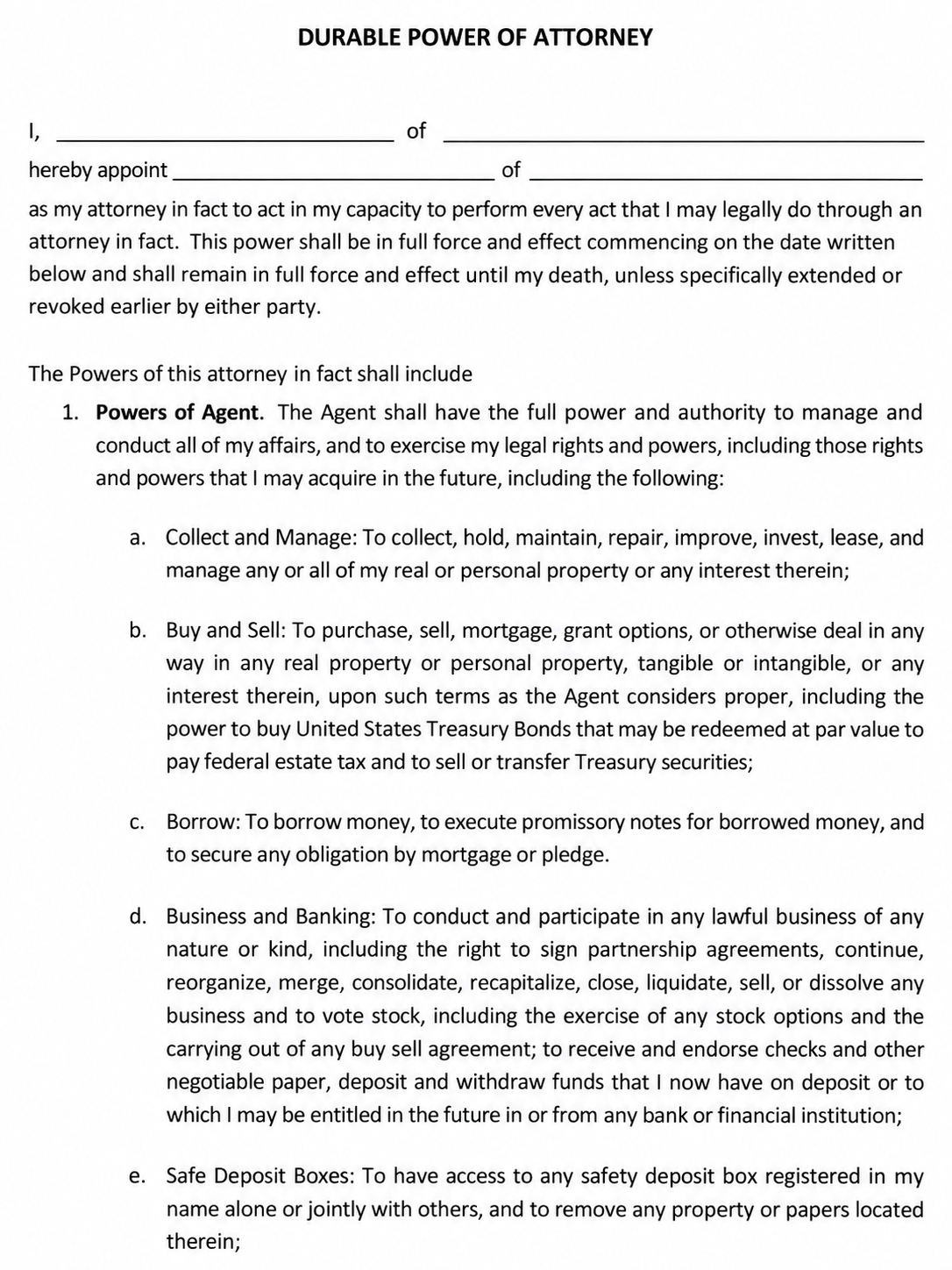
Example of a Power of Attorney Form
Power of attorney forms typically identify the person granting authority, the person being appointed, the powers being granted, any limitations or special instructions, and the conditions under which the authority begins or ends.
Common questions
What is a durable power of attorney?
A durable power of attorney is generally designed to stay in effect if the principal becomes incapacitated. Whether a particular power of attorney is durable depends on its terms and on the state law that applies to it: in some states a power of attorney is durable unless it says otherwise, while in others it must contain wording that makes it durable. Read the form carefully.
Should I use a state form or a general form?
Where we have a form written for your state, start with that form. General forms are not written for any one state's rules, so check your state's requirements before using one.
Is a medical power of attorney the same as a living will?
No. A medical power of attorney generally appoints someone to make health care decisions for you if you cannot make them yourself. A living will generally records your own wishes about medical treatment and does not appoint an agent. Some states combine both in a single advance directive form, and the names, scope and requirements of these documents vary by state.
Can a power of attorney be revoked?
Generally, a principal who still has the legal capacity to do so can revoke an ordinary power of attorney, and a revocation form can be used to put the revocation in writing. How a revocation must be made, when it takes effect and who must be notified depend on the applicable law and on the document itself, and different rules can apply to a power of attorney that its terms or the law make irrevocable. Notify the agent and anyone who has relied on the original document: in many states, people who act on it in good faith without knowing of the revocation are protected.
Does a power of attorney need to be witnessed or notarized?
It depends on the state and the type of document. Follow the signing instructions in the form and the rules that apply where you live.
Important Legal Information
Power of attorney laws and requirements vary by state. Before using a form, review it carefully and confirm any applicable rules regarding signatures, witnesses, notarization, or other legal requirements in your jurisdiction.
The authority granted by a power of attorney can vary significantly depending on the document. Make sure the form clearly reflects the powers you intend to grant and any limits or conditions that should apply.
The forms provided on this website are for general informational purposes and are not a substitute for legal advice. Free Printable Legal Forms does not assume responsibility for the accuracy, completeness, effectiveness, or use of any form provided on this website.
Can’t Find the Form You Need?
Search all available legal forms by keyword, state, or category.
Search All Legal Forms →